Each farmstead at Bryggen housed a number of individual properties, the dwellings. Each farmstead also had common properties, consisting of a quay, sheds, a crane, and a Schøtstuen with a fire room. The construction and maintenance of these properties were paid for by all the dwelling owners in the farmstead.
The accounts were recorded in the farmstead’s common ledger, the ‘mascopibok’. This book was kept by elected officials. Each farmstead, in fact, had its own administration and court.
Each farmstead had a Schøtstuen with a fire room at the very back of the row of houses. The Hanseatics adopted the system of shared Schøtstuen and fire room from the earlier Norwegian inhabitants of Bryggen.
The Norwegian word for this building was ‘skytning’ or ‘skytningsstove’. The Hanseatics changed this designation to ‘Schotstube’ or ‘Schutstaven’.


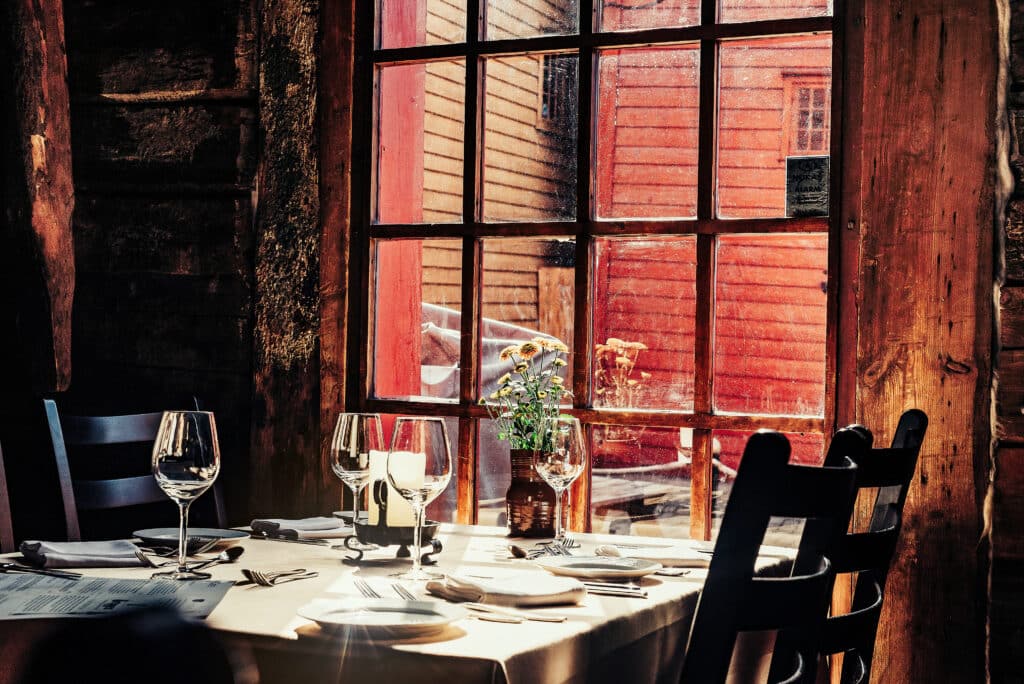
The main purpose of the Schøtstuen was to be a gathering place for the farmstead’s people during the winter months, and in combination with the fire room, it served as a dining area where warm meals were served. While the dwellings at the front of the farmstead were unheated, the Schøtstuen was heated from late October to mid-April. During this period, there was less activity in the warehouses and the ‘sjøstue’ (seaside room), and therefore, much of the day was spent in the Schøtstuen.
The Schøtstuen was more than just a common room. It also served as:
Once a year, a court session was held in the Schøtstuen, where the farmstead’s own people could be judged for breaking internal rules. Punishments varied according to rank:
The money went to charity, or was used for a communal feast with so-called ‘free beer’.
Fines could also be given in beer, and the strictest fine amounted to a whole barrel. This was, among other things, the punishment for impregnating someone in Bergen – something the Hanseatics, who lived in celibacy, were not supposed to do. The fine was consumed communally in the Schøtstuen. This contributed to a form of social control, where everyone looked out for each other’s moral conduct – a practice known from guilds and brotherhoods across Europe.
In winter, a schoolroom was held for the apprentices in the Schøtstuen. The teaching included writing, arithmetic, and product knowledge – necessary groundwork for future experts in stockfish and cod liver oil. They also had to be able to keep complex accounts.
Moral instruction took place through daily devotions and hymn singing, as well as through rules of conduct among members. The Schøtstuen was thus also a space for shaping character and community spirit.
All funerals originated from the Schøtstuen. The coffin was carried in procession from there to St. Mary’s Churchyard – a final ceremony from the heart of the community.
Each Schøtstuen had its own regulations and administration. The farmstead’s ‘buherre’ (head of the household) was in charge of the administration. He also held the keys to the storehouse, the common money chest. By his side, he had the beer buyer and the wood buyer, two important individuals. In addition, the administration consisted of a ‘gesellhøvedsmann’, a scribe, and a ‘Buttenkyker’,
The ‘gesellhøvedsmann’ was responsible for reading out the Schøtstuen’s regulations six times a year, so that all members were reminded of the current rules. The scribe meticulously recorded every matter that was brought up, while the ‘Buttenkyker’ supervised the fire room. Every fortnight, he inspected buckets and tubs to ensure everything was clean and in good condition.
– also called the ‘Recke-mann’ – was responsible for the apprentices’ behavior. He carried the symbolic ‘reckestokk’ (punishment stick) as a sign of his authority. This stick often had a pointing hand at its end, and with it, he pointed out those who broke the rules. The names of the guilty were written on the ‘sortebrett’ (list of offenders) and later dealt with during court sessions, where appropriate punishment was given.
If the ‘Recke-mann’ became distracted by the beer and wasn’t paying attention, a quick person could snatch the stick and knock on the door of the beer cellar with it. To get the stick back, the ‘Recke-mann’ had to buy a jug of beer for the person who had taken it – a kind of humorous game that simultaneously reminded him of his duty.
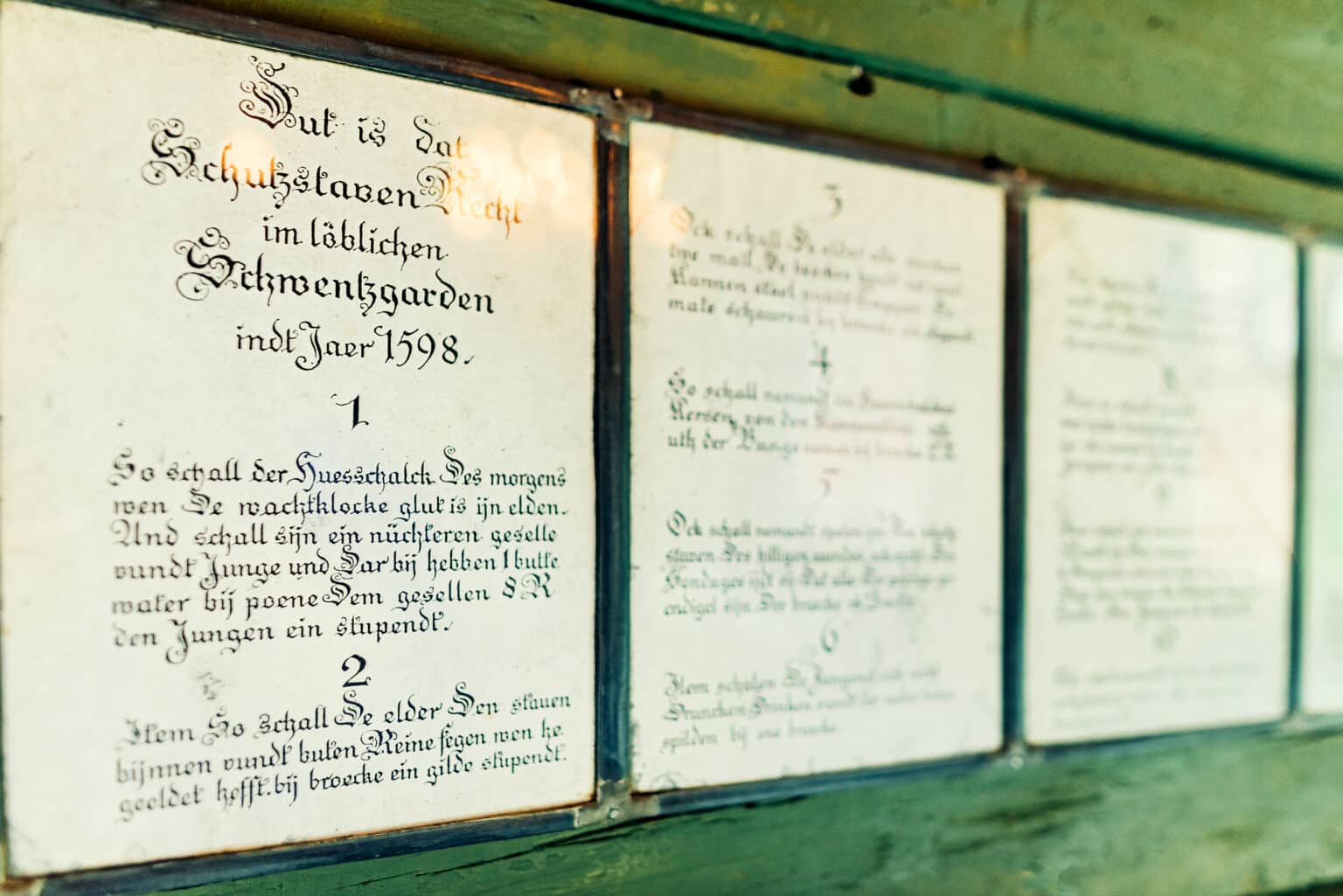
Hung visibly on the wall, accessible to everyone. Among other things, it stated that there always had to be a sober journeyman present, equipped with a fire hose and a bucket of water. It was not allowed to stay overnight in the Schøtstuen, and apprentices were not allowed to fight, pull each other’s hair, or behave badly.
Seating in the Schøtstuen followed a fixed hierarchy. In the early years, officials had their own bench, but from the late 1600s, the oldest merchant or trade manager was seated at the top of the room. Thereafter, the other members followed in order of age. Journeymen and apprentices had their own places, most often arranged so that people from the same dwelling sat together.